How many people does it take to act on an insight? Ideally one but usually it's more like three.
Data owns the facts. Finance owns the plan. The operator owns the result. Three seats, three partial stakes, one decision.
So when the number comes in lower than expected, the room asks the obvious question: what's wrong with the number?
Everyone looks at everyone.
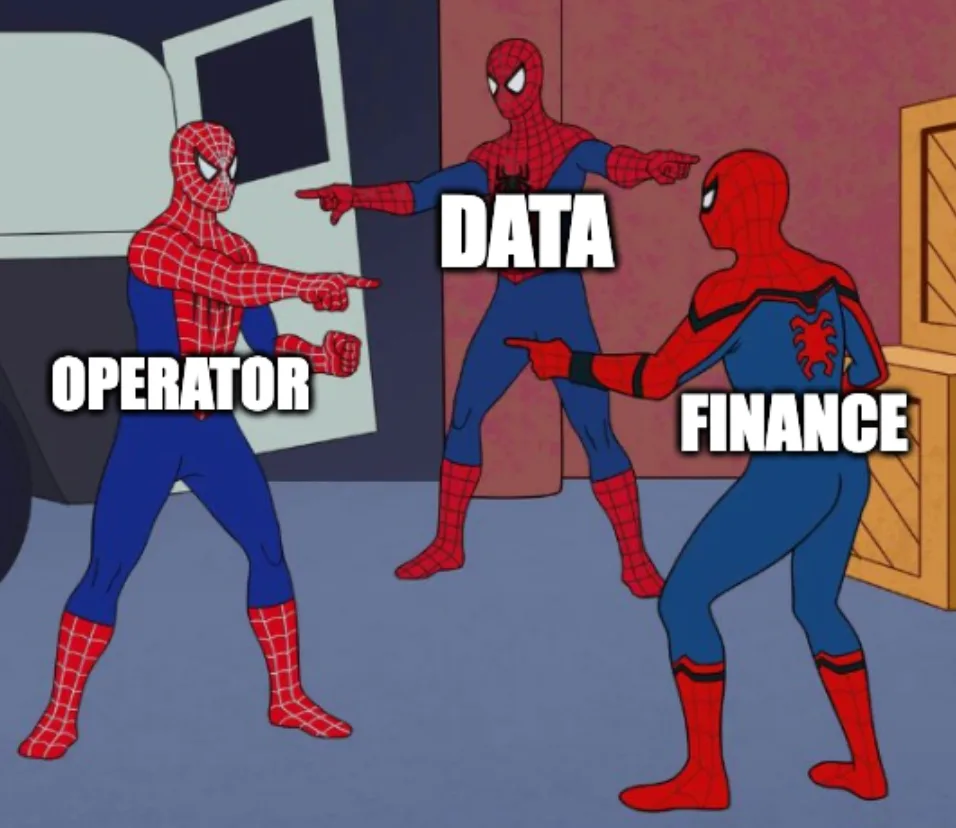
It's easy to call this a process problem. It's structural. Each seat is doing exactly what its stake tells it to do.
The finance person owns a plan that may never have reconciled top-down against bottom-up, with variance nobody measures and nobody's graded on. The operator is accountable for the result and can't make the call alone without absorbing the risk of a plan they didn't ratify. The data person is expected to recommend a path while having nothing on the line.
Accountability requires a neck but the org chart cuts it three ways.
No call is safer than a bad one. Tolerable a few times a year. A few times a quarter kills roadmaps and morale.
I've called this organizational theater in the past but there's a service being performed. Data owns definitions, so the operator can't redefine the metric to fit the result. Finance owns the plan, so the operator can't set their own bar.
But then the plan becomes the bar.
The operator stops steering toward outcomes and starts steering toward finance's number. Goodhart, right on schedule. The check that kept the operator honest is now what's bending the call. Rigor is necessary to reduce bad decisions. But how many good decisions go unmade?
Nobody consolidates headcount to fix decision-making. They do it because the math on cost per head got better. With AI offering ground truth to everyone, fewer rungs in the information ladder should yield faster outcomes. Frictionless context, facts and forecasts, more revenue per head. The logic holds.
Now when the number comes in lower than expected, the operator can prompt out some chicken scratch to land a passable narrative. Nobody's the wiser. Faster, though.
Checks and balances existed to minimize expensive mistakes. The dog and pony show was the price of admission. AI just made it a one-person play.